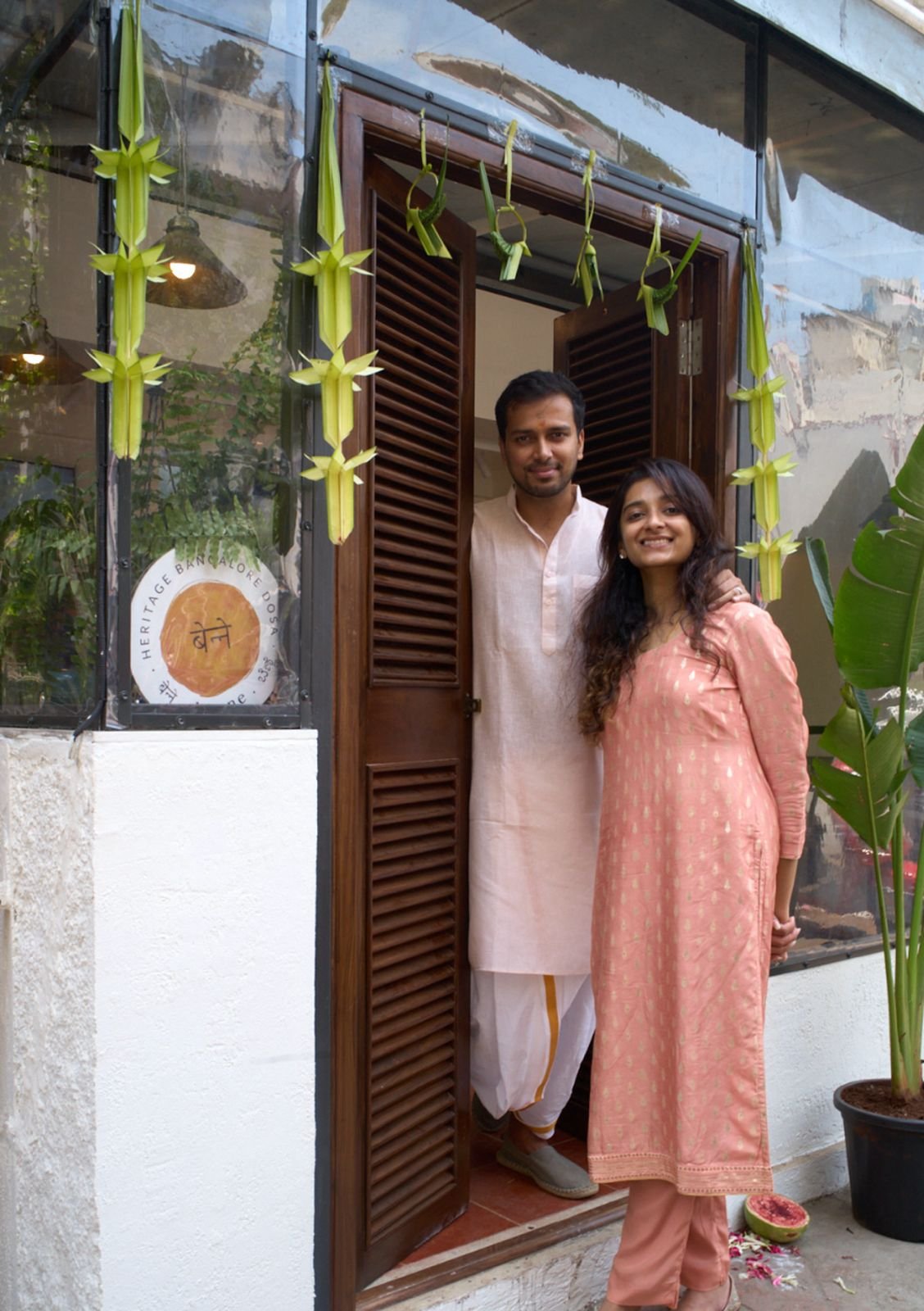
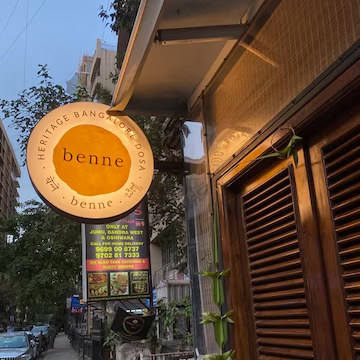
This shift has caught the eye of serious money. Family offices, angel investors, and private equity funds that once stayed away from restaurants are now writing cheques for this kind of brand. South Indian quick-service formats, in particular, are having a moment. Names like The Rameshwaram Cafe and Cafe Amudham have shown that a simple, well-run idea, often built around one hero dish, that can scale fast and pull in real investor interest. Benne fits right into this story. What started as a tiny 12-seater dosa counter in Mumbai’s Bandra has grown into one of city’s most talked-about food brands, known for its buttery, Bangalore-style benne dosa and its long, patient queues.
From a Craving to a Funded Company
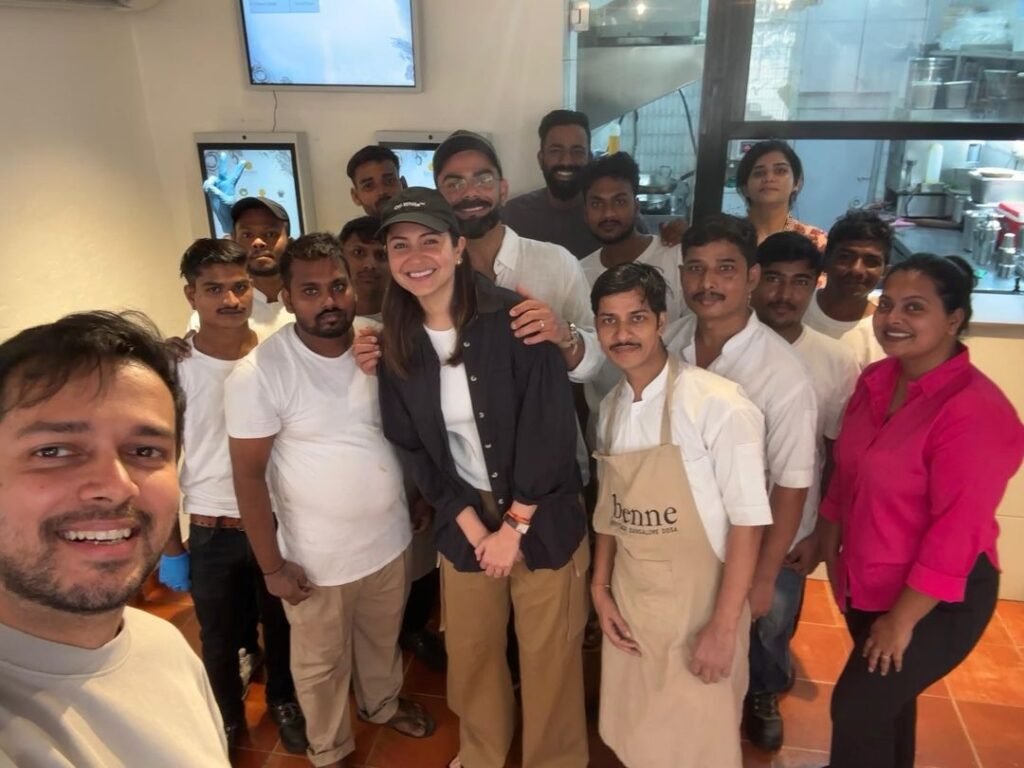
Benne was started in 2024 by husband-wife duo Akhil Iyer and Shriya Narayan. Neither had a hospitality background; Akhil had spent over a decade as a filmmaker, and Shriya trained as a counselling psychologist. The idea came from something personal: after moving to Mumbai, the Bengaluru-origin couple couldn’t find the Davangere-style benne dosa they grew up eating, so they decided to make it themselves. What began as a small, standing-only outlet in Bandra soon turned into a citywide sensation, helped along by honest, behind-the-scenes storytelling on Instagram, long queues, and visits from celebrities like Deepika Padukone, Ranveer Singh, Virat Kohli, and Anushka Sharma. The brand has since expanded to four outlets, Bandra, Juhu, and Chowpatty in Mumbai, plus a Delhi outlet in Greater Kailash 2 that opened on New Year’s Eve 2025.
The bigger news:
Benne recently closed a pre-Series A funding round, raising Rs 35 crore led by Claypond Capital, the family office of billionaire investor Ranjan Pai. Other investors in the round include AL Trusts, ace investor Mukul Agrawal, Madhukeshwar Desai, and Cortado Advisory Services, with earlier backing from venture firm Peercheque. With fresh capital in hand, Benne is set to open more outlets and strengthen its back-end systems. Interestingly, there’s no word yet of a franchise model. Reports so far suggest Benne is sticking to a company-owned expansion plan, growing its own outlets rather than handing the brand to franchise partners, at least for now.
Against this backdrop of funding, growth, and rising demand, Kitchen Herald sat down with Akhil to understand what actually goes into building a brand like Benne, before the money and now, with it. “We Knew Absolutely Nothing” Akhil doesn’t dress up, how unprepared he and Shriya were when they started. “It was completely new territory for us. Everything was a big lesson because we knew absolutely nothing, and I still feel like we are learning a lot every day.” Their biggest early struggle was consistency, getting the same quality of food, every single day, with a mostly unskilled and untrained team. “Those were some of our biggest challenges, trying to find standardization, trying to make sure that everything is the same every day from a food quality standpoint, with no loss at all.”
Since Benne isn’t led by a celebrity chef, Akhil says systems had to do the heavy lifting instead. “It’s more of a process- and system-driven company, with a lot of tradition and values and some very key recipes at its core.”
Growing Without Spending a Rupee on Ads.
One of the most surprising parts of Benne’s story is that it never paid for marketing. “We had zero paid marketing. What worked instead was honesty. We were communicating on Instagram much before we opened, in a way that was true to who Shriya and I are, not glossy finished-product shots, but the real journey of setting up and running a cafe. That honesty turned into real word-of-mouth. The people who came to us early spoke to others and posted about it. It’s extremely organic, and we’re grateful to everyone who’s ever visited, Benne.” Even negative feedback is welcomed, he adds, “it helps us improve, because we are a work in progress.”
Keeping Quality Steady While Growing Fast
As Benne moves from a single tiny outlet to multiple formats, keeping the food the same everywhere is a daily challenge. “Standardization has been one of our goals for the last year and a half. The real work happens behind the scenes, with a central kitchen, strict timing and quantities, careful sourcing, and close attention to how the batter is soaked, ground, and transported between locations. Growth speed is something the team watches closely too. Sometimes it feels like we are running faster than we should, and the moment we feel that, we check ourselves and take corrective measures. We are growing at a pace we can sustain and that’s the most important part,” he adds,
Getting the Dosa Right
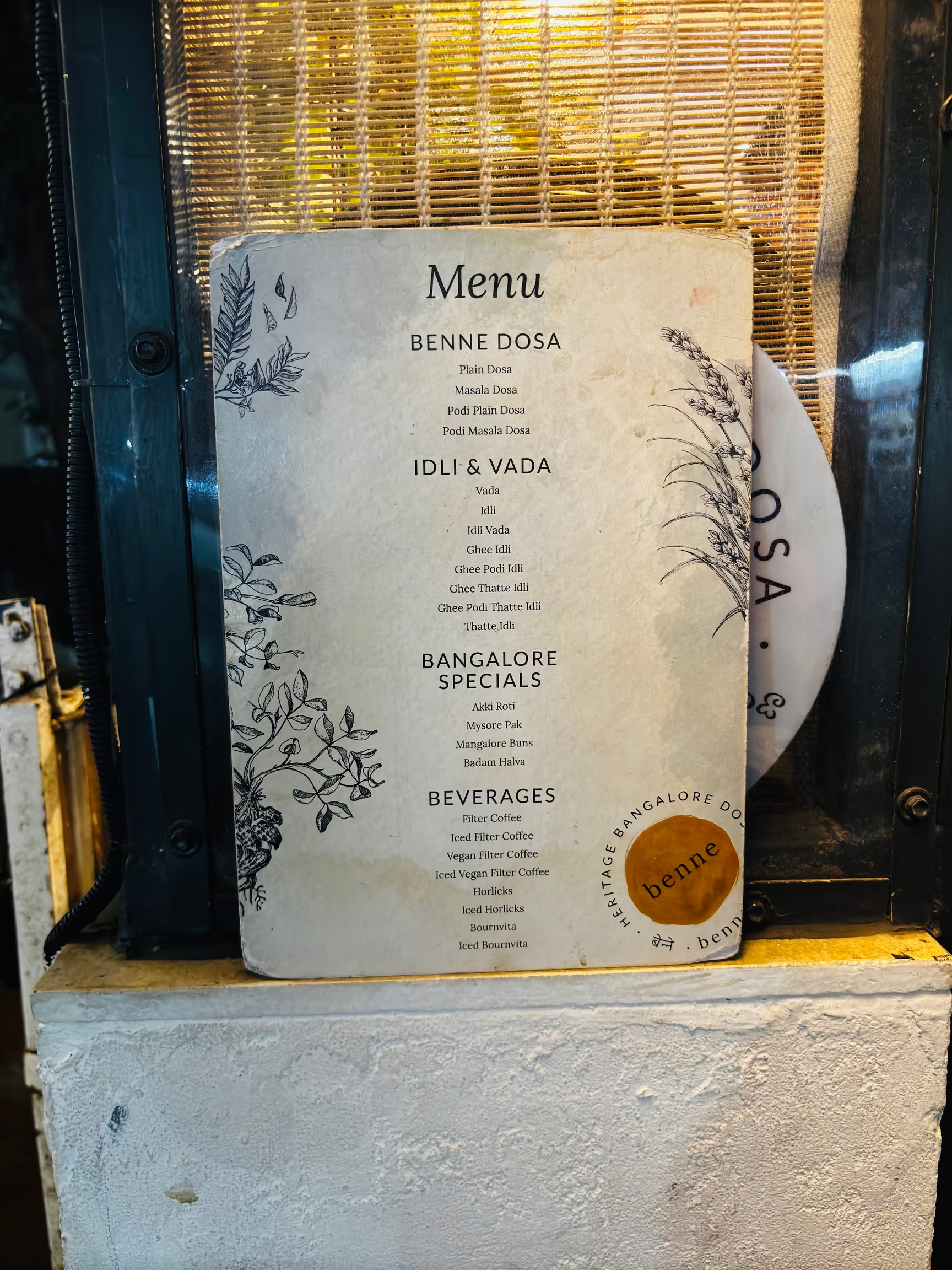
Akhil is quick to clarify one thing: Benne’s dosa is Bangalore-style, not Davangere-style, and that distinction matters to him. The menu, he says, was kept deliberately small. “It was very clear that we should have a very short, concise menu, try to do a few things and do them well, with a lot of care and love,” balancing tradition with a modern customer experience.
Choosing Locations the Hard Way

On real estate, Akhil is upfront about the trade-offs. “We’ve chosen high-street locations, which sometimes means higher rent, but location is extremely important, you want to be present where people would frequent.” Outlet sizes have varied too, as the team keeps testing what format works best.
His Only Piece of Advice
Asked for a leadership lesson, Akhil stays humble. “I don’t think I’m the right person to give anybody else advice,” he says, before offering one anyway: “Try to create something that you believe in. Try to be honest. Try not to copy anybody else, just be the authentic version of yourself, and let decisions flow from there. Try not to start with a loan. Even if you need to save up and start small, that’s a better way to start. With fresh funding now in the bank and four outlets across two cities, Benne’s real test is just beginning, whether a brand built on a small kitchen, a short menu, and a lot of honesty can grow big without losing what made people queue up for it in the first place.” he concludes.