

-Khwaish Hingad
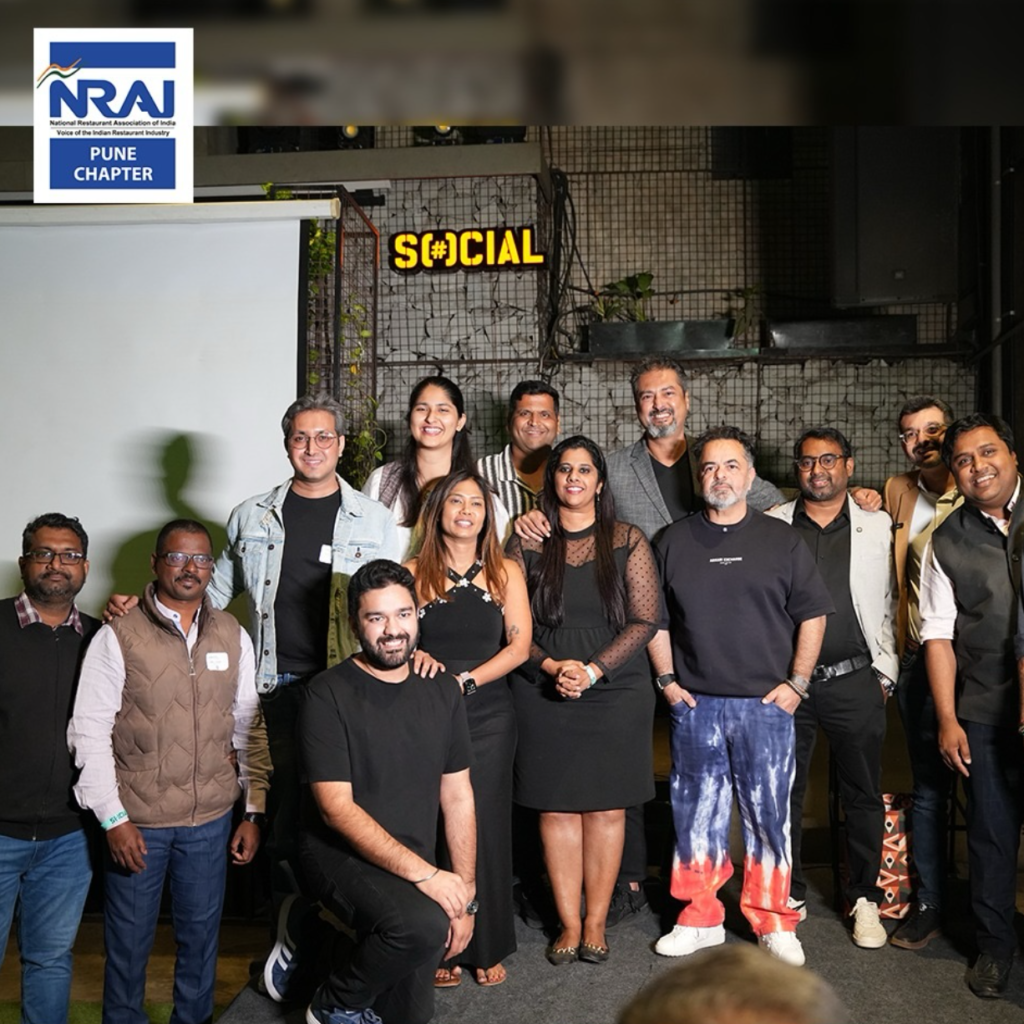
Pune’s restaurants survived Covid. But survival didn’t mean smooth sailing. In the years since, the city’s food and hospitality industry has lurched from one crisis to the next: an LPG shortage that shut down commercial kitchens overnight, a regulatory crackdown following the 2022 Porsche incident that forced several establishments to permanently down their shutters, and now an acute water shortage as monsoons delay their arrival. For operators on the ground, it has felt less like recovery and more like a relay race of emergencies. Saili Jahagirdar, Chapter Head of NRAI Pune and owner of Zillionth Bistro & Billion Burgers, sat down with Kitchen Herald to talk about what the industry is actually dealing with and what it needs to get out of survival mode for good.
The FSSAI Problem: Information, Not Compliance
Of the many pressures weighing on Pune’s operators, Jahagirdar is careful to separate the ones that stem from bad regulation from the ones that stem from poor communication. FSSAI, she argues, falls firmly in the latter camp. The problem isn’t that the norms are unreasonable. It’s that restaurants often don’t know which norms apply to them in the first place.
“So many times we do not get updates because there are no press releases. The information is incomplete. The information is half-baked. There are no circulars coming to us.” Smaller establishments, she notes, bear the brunt of this ambiguity, left to interpret a compliance framework without a clear entry point. “Understanding the points that you have to be eligible for or that you have to fulfil, that is the biggest pain area with FSSAI. The communication is not right from their end.”
What NRAI Pune is asking for isn’t a rollback of standards but a functional roadmap. “As far as following regulations is concerned, that is not a challenge. But having a roadmap to reach the points that FSSAI tells you to follow, that is the challenge.” It’s a distinction that matters, because it shifts the conversation from operators resisting accountability to operators asking for clarity, a far more reasonable ask, and one the regulator has yet to adequately address.
Rising Input Costs and the Labor Drain
If FSSAI represents the regulatory pressure, input costs and labor represent the operational grind, and on both fronts, the situation has worsened considerably. LPG prices have nearly doubled in some cases over the past few months. Real estate costs continue to climb. And the association has had to step in where the system hasn’t.
During the LPG crisis, NRAI Pune didn’t wait for a government solution. The chapter coordinated directly with MNGL, obtained the necessary permissions, and fast-tracked approximately 1,000 applications from member restaurants to switch to piped natural gas connections. “That is the job of the association,” Jahagirdar says. “Irrespective of whatever your input costs are, you have to keep finding solutions for the fraternity.”
Labor, however, is a problem the association cannot solve on its own. A significant portion of trained hospitality manpower has left for the Middle East, drawn by better pay and stability. “That leaves India and Asia scrambling, honestly.” Her prescription for members is unsentimental: automate where possible, reduce dependency on headcount, and build outlets that are self-reliant by design. “That is the only way to look at it.” The subtext is clear. The labor pool is not coming back, and the industry needs to plan accordingly.
GST Input Tax Credit: A Multi-Year Fight
The cost pressures don’t end at the kitchen door. On the taxation front, the restaurant industry continues to operate under a structure that Jahagirdar describes as fundamentally unfair. Restaurants pay 5% GST on bills with no provision for input tax credit on the supplies and infrastructure that go into running an establishment. NRAI has been fighting this for nearly five years, including through the High Court.
“We are fighting for input tax credit. Restaurants should be eligible to get input tax and there has to be a proper policy around it.” The irony, she points out, is that the aggregator layer has made an already complicated tax structure even harder to navigate. Restaurants now face GST obligations on delivery platform commissions separately from their core business revenues. “There is a burning need for very strong policies to come in place for GST for the hospitality sector.”
It is precisely this kind of systemic disadvantage, unresolved across multiple governments and multiple years, that brings Jahagirdar to NRAI Pune’s central, most ambitious demand.
The Bigger Mission: Industry Status
Ask Jahagirdar about NRAI Pune’s priorities, and she is quick to move past the obvious asks: late-night permissions, outdoor seating approvals, and state-level licensing reforms. “Trivial,” she says, not dismissively but strategically. Because if NRAI gets what it is actually pushing for, all of those issues resolve themselves downstream.
What NRAI is fighting for at the national level is the formal recognition of the hospitality sector as a designated industry, the same status accorded to tourism, steel, textiles, and dozens of other sectors that come with their own policy frameworks, ministry representation, GST structures, and entry regulations.
“Today, the hospitality sector does not get an industry status. We are not recognized as a separate industry.” The consequences of that absence are tangible. There are no entry barriers, which means the market is flooded with unregulated competition. There is no dedicated ministry, which means the industry has no single point of advocacy. And there are no structured subsidies or tax reforms, because without formal recognition, the sector doesn’t fit neatly into any reform agenda.
Jahagirdar illustrates the entry barrier problem with an analogy that is hard to argue with. To set up a steel plant, she explains, even if you have the money and the investors, you cannot simply begin. There are hundreds of eligibility criteria, clearances, and regulations that must be met first. “In restaurants, whoever has the money to open a restaurant or a cloud kitchen or a cafe, and whoever wants to, they can open it.” The result: a home baker selling cheesecake at Rs.200 from their kitchen can undercut a licensed restaurant selling the same product at Rs.300, without paying for commercial cylinders, a separate water connection, a commercial electricity meter, or ten employees. “And you can’t stop it.”
“Once you get an industry status, all these things start getting regulated. There will be reforms, there will be rules, there will be policies, there will be subsidies. There will be a structure.” The parallel she draws is tourism, recognised as an industry, backed by government policy, and structurally supported in ways hospitality simply isn’t. “Hospitality is the largest employer in the country and one of the largest revenue generators. We are not asking something extraordinary. We are just saying: give us the same treatment that is given to other industries.”
Aggregators: Duopoly, Disruption, and Dialogue
The industry status debate also has a direct bearing on one of the sector’s most contentious current issues: the aggregator ecosystem. Because without regulatory structure, platforms like Swiggy and Zomato operate in a space where commission rates, currently touching 30-32%, face no meaningful check.
“Show me one industry where the commission is 30%, 32%. There is no industry that pays such high commission to any kind of aggregation.” For cloud kitchens entirely dependent on online delivery, Jahagirdar says profitability is structurally near-impossible at those rates. The root cause, she argues, is duopoly. With only two dominant players setting the terms, restaurants have little negotiating power. “The moment there are two more players, the duopoly breaks.” She points to the telecom sector’s transformation when Jio entered as a reference point. Prices dropped, services improved, and consumers benefited almost immediately.
In the interim, NRAI Pune is actively pushing members toward zero-commission alternatives: ONDC, Vayu, and Rapido’s upcoming food delivery launch in Pune, which is expected to cap commissions at 5%. “NRAI 100% promotes them,” she says.
But Jahagirdar is careful not to let the chapter’s frustration curdle into animosity. “You cannot ignore the fact that they are a part of your ecosystem.” She describes an upcoming joint event with the Pune head of Zomato as a deliberate signal of the collaborative stance she wants NRAI Pune to project. “Aggregators will survive only if restaurants survive. For restaurants also, having these aggregators is extremely important for their survival. It works both ways.” The long game, she suggests, is not to fight the platforms but to change the conditions in which they operate, through more competition and eventually through the kind of regulatory framework that only industry status can deliver.
Retail Landscape and Legacy Brands
On the question of Pune’s rapidly shifting retail geography, new malls in Kharadi, high streets in Hinjewadi, micro-markets in developing corridors, Jahagirdar is notably calm. New infrastructure, she argues, isn’t a threat to existing restaurants. It’s an opportunity. “Shifting landscape means more food journeys.” Restaurants are an inbuilt part of any new commercial development, not a casualty of it.
The real competitive threat, she says, is not new locations but unregulated density within existing ones. “15 restaurants serving Chinese in one kilometre radius, that is a problem.” It circles back, once again, to the industry status argument: in a regulated sector, such concentration would face natural limits. Without it, the market self-regulates through attrition.
Legacy brands, for their part, are not standing still. “At least in Pune, I know so many legacy brands that are studying the patterns. Who is my customer base? What do they want? What should be my price point? How should my product change for them? Anybody who is surviving or thriving in the market today is because of that.” Adaptation, not nostalgia, is what keeps established names relevant.
Vision: A Thousand-Member Chapter
All of these battles, FSSAI communication, GST reform, aggregator commissions, industry status, ultimately come back to one thing: the strength of the association fighting them. And on that front, Jahagirdar has a clear near-term target: 1,000 members for the Pune chapter.
The reasoning is explicitly political. “When you are a thousand-member association, your voice gets heard by politicians, by policymakers, by government, by press, by media, and that starts bringing in the required change.” A single restaurant owner approaching an excise commissioner, she notes, carries a fraction of the weight of a unified body with four-digit membership. “The press is waiting outside. Because it is the community that has the power.”
It is, in many ways, a microcosm of everything NRAI Pune is fighting for at the macro level: the idea that structure, recognition, and organised representation are not luxuries but prerequisites for change. “For as long as I am in the industry, I will ensure that we follow through on this.”
The industry status fight may be a long one. But in Pune, at least, it has a chapter head who isn’t counting on it resolving itself.
