

By B. Swaminathan | swami@imaws.org
Beyond raids and licence renewals, the Food Safety and Standards Authority of India (FSSAI) is pushing hotels, restaurants and food manufacturers to treat compliance as a daily habit rather than a once-a-year scramble. In the concluding part of Kitchen Herald’s exclusive interview, Rajit Punhani, IAS, Chief Executive Officer of FSSAI, laid out what daily discipline, Centre-State coordination and digital tools mean for the industry’s food safety culture.
Daily Discipline Over Last-Minute Scrambling
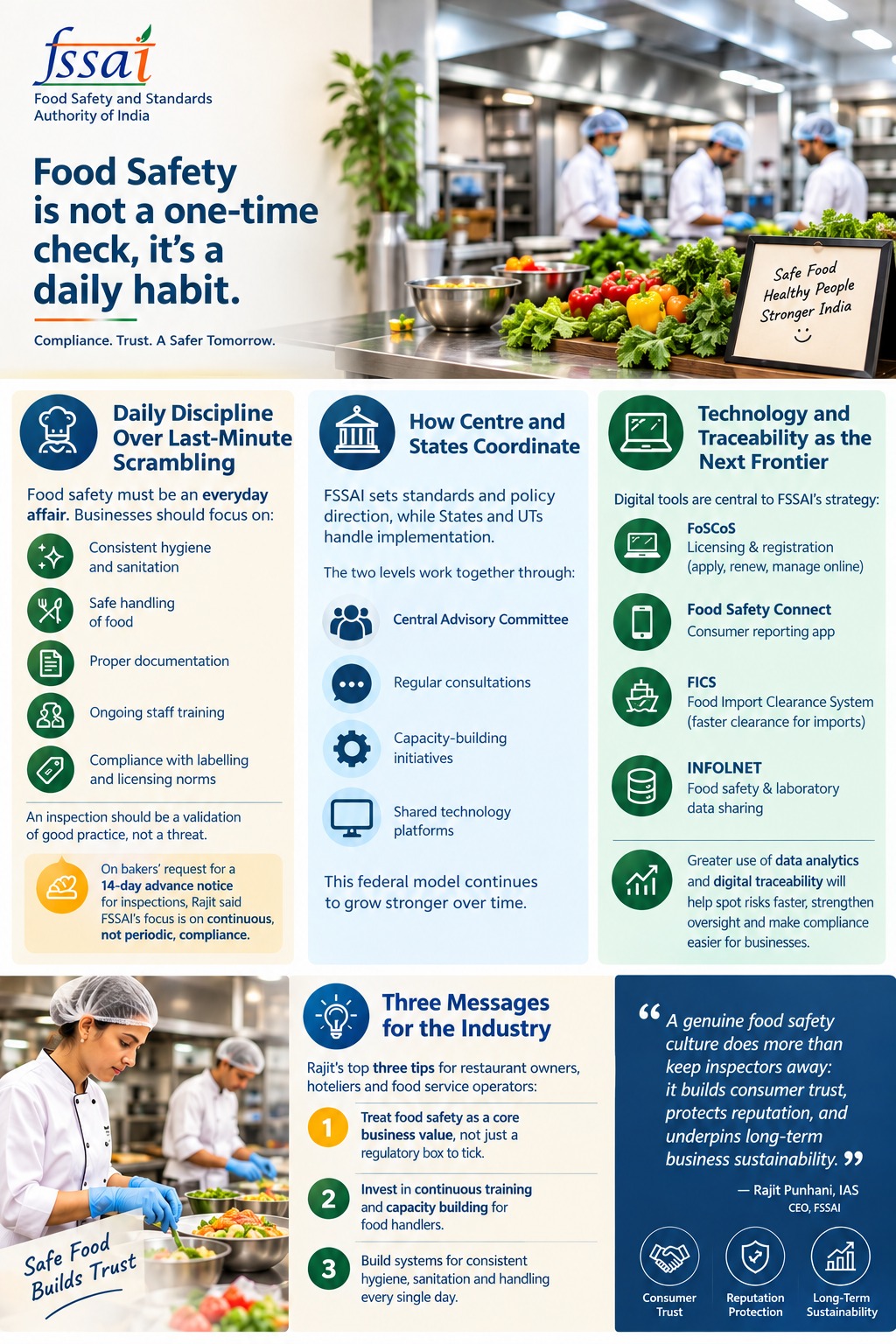
On what restaurants and hotels should do daily to stay audit-ready rather than scrambling only when a raid is announced, Rajit’s message was that food safety must be an everyday affair: consistent hygiene and sanitation, safe handling, proper documentation, ongoing staff training, and compliance with labelling and licensing norms. Businesses that embed these into daily operations, he said, should experience an inspection as validation of good practice rather than a threat. Kitchen Herald also raised bakers’s specific request for a 14-day advance notice period ahead of inspections; Rajit did not commit to it directly, framing his
response instead around continuous, not periodic, compliance.
How Centre and States Coordinate
Since enforcement largely sits with state-level Food Safety Departments (FSDAs) while FSSAI sets standards centrally, Kitchen Herald asked how well the two levels are coordinated. Rajit called this the essence of India’s federal system: FSSAI lays down standards and policy direction while States and UTs handle implementation. The two levels work together through the Central Advisory Committee, regular consultations, capacity- building initiatives and shared technology platforms, an arrangement he said continues to strengthen over time.
Technology and Traceability as the Next Frontier
Digital tools are becoming central to FSSAI’s strategy. FoSCoS remains the core platform for licensing and registration, letting operators apply for, renew and manage requirements online. The Food Safety Connect app gives consumers a direct channel to report concerns. On the trade side, the Food Import Clearance System (FICS) speeds up clearance of imported consignments, while INFOLNET supports collection and sharing of food safety and laboratory data. Together, these platforms help FSSAI adopt a more risk-based approach, integrating information across sources to spot emerging risks faster. Going forward, greater
use of data analytics and digital traceability across the supply chain is expected to strengthen oversight further while helping compliant businesses demonstrate compliance more easily.
Three Messages for the Industry
Asked to leave Kitchen Herald’s readers, largely restaurant owners, hoteliers and food service operators, with his top three messages on building a genuine food safety culture beyond avoiding penalties, Rajit offered a clear checklist: treat food safety as a core business value, not merely a regulatory box to tick; invest continuously in training and capacity building for food handlers; and build systems that ensure consistency in hygiene sanitation and handling every single day. A genuine food safety culture, he concluded, does more than keep inspectors away: it builds consumer trust, protects reputation, and underpins long-term business sustainability.
