

By B. Swaminathan | swami@imaws.org
With food safety raids making headlines across India, restaurant and hotel owners are increasingly asking a practical question: what actually sets off a raid? In an exclusive interview with Kitchen Herald, Rajit Punhani, IAS, Chief Executive Officer of the Food Safety and Standards Authority of India (FSSAI), addressed this along with growing concerns around street vendor regulation.
From Tip-Off to Inspection
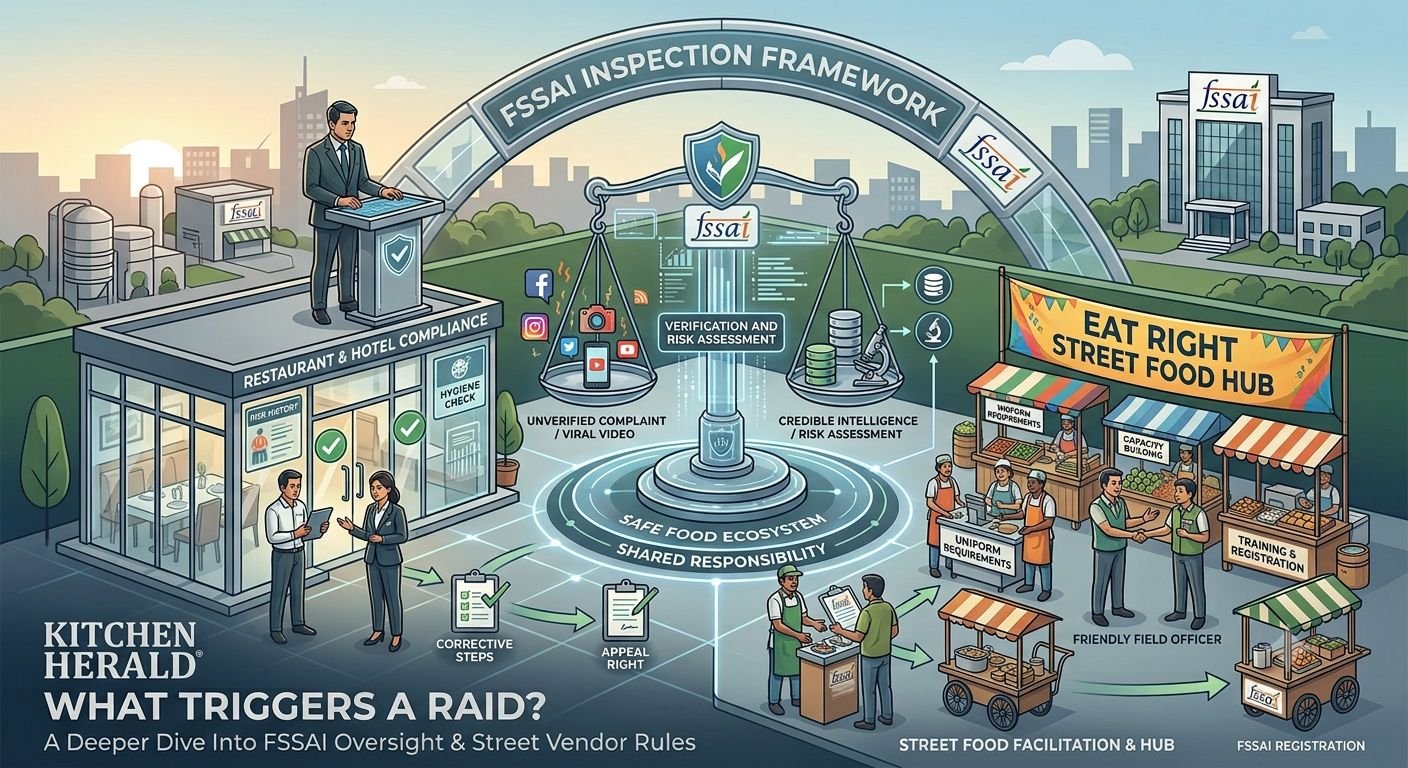
There is growing anxiety in the age of artificial intelligence and social media that a single malicious complaint or viral video could unfairly damage a restaurant’s reputation before facts are verified. Rajit clarified that inspections are primarily risk-based, factoring in the nature of the business, its compliance history and potential public health risk. FSSAI does act on consumer complaints and credible intelligence from various channels, but no action is triggered purely on unverified information; complaints are assessed and verified first.
When a restaurant is flagged, the response depends on the nature and severity of the violation. The business gets a chance to take corrective steps and respond to the observations raised. Suspension or cancellation of a licence, Rajit stressed, is reserved for cases where the law warrants it, not a default response. Operators also have a formal right of appeal under the Food Safety and Standards Act and its regulations.
Street Vendors: Facilitation, Not Just Regulation
On why regulatory pressure appears concentrated on tax-paying, law-abiding small restaurants while street food remains loosely governed, Rajit was clear that food safety requirements apply uniformly across vendors, restaurants, hotels and large manufacturers. However, he acknowledged street food is a largely unorganised, diverse sector that calls for a facilitative approach alongside regulation rather than heavy-handed enforcement.
FSSAI runs initiatives such as Eat Right Street Food Hubs, along with training and capacity- building programmes to improve hygiene and safe handling among vendors. The registration process has also been simplified: any vendor already registered under the Street Vendors (Protection of Livelihood and Regulation of Street Vending) Act is deemed registered under FSSAI too. The intent, he reiterated, is not to single out any one segment but to strengthen food safety across the ecosystem so consumers get safe food wherever they choose to eat.
