

-By B Swaminathan (swami@imaws.org)
The restaurant business has always been visual. From hand-painted boards outside a neighbourhood cafe to glowing LCD panels in a hotel lobby, how food is displayed shapes how guests feel before they have taken a single bite. But something has been quietly broken about the digital signage revolution for years — and most operators have simply accepted it.

Walk into almost any modern food service outlet and you will find screens running continuously: broadcasting videos nobody is watching, cycling through promotions that could just as easily sit on a printed sheet. “When you go to a restaurant, people don’t want to watch a video,” says Dr. Ajit Aras, Executive Vice President at Sharp Singapore Electronics Corporation. “It is actually distracting. You want to see a painting, a picture, or a promotion — static content that is there when you need it.” Yet the LCD and LED-backlit screens delivering that static content consume power around the clock, whether the content changes or not.
From Brushstrokes to Backlit Panels — and Back Again
The journey of restaurant display has moved in a neat arc. Painted menus gave way to printed paper, which gave way to electronic screens promising flexibility and dynamism. But that dynamism came at a cost. LCD and LED-backlit screens — which Dr. Ajit is careful to distinguish as LED-backlit LCDs rather than true LEDs — guzzle energy continuously. For operators showing the same lunch menu for five unbroken hours, that energy spend is entirely wasted.
It is a tension the industry has quietly tolerated for years: the environmental and economic cost of digital flexibility versus the inflexibility of print. “There is a dilemma,” Dr. Ajit says, “between traditional paper — static, sustainable, but throwaway — and electronic content that is also static but consuming enormous energy.”
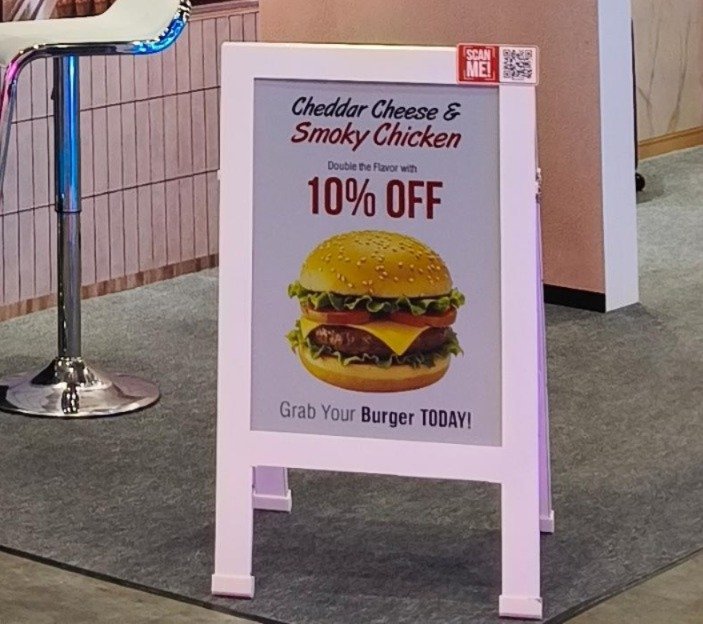
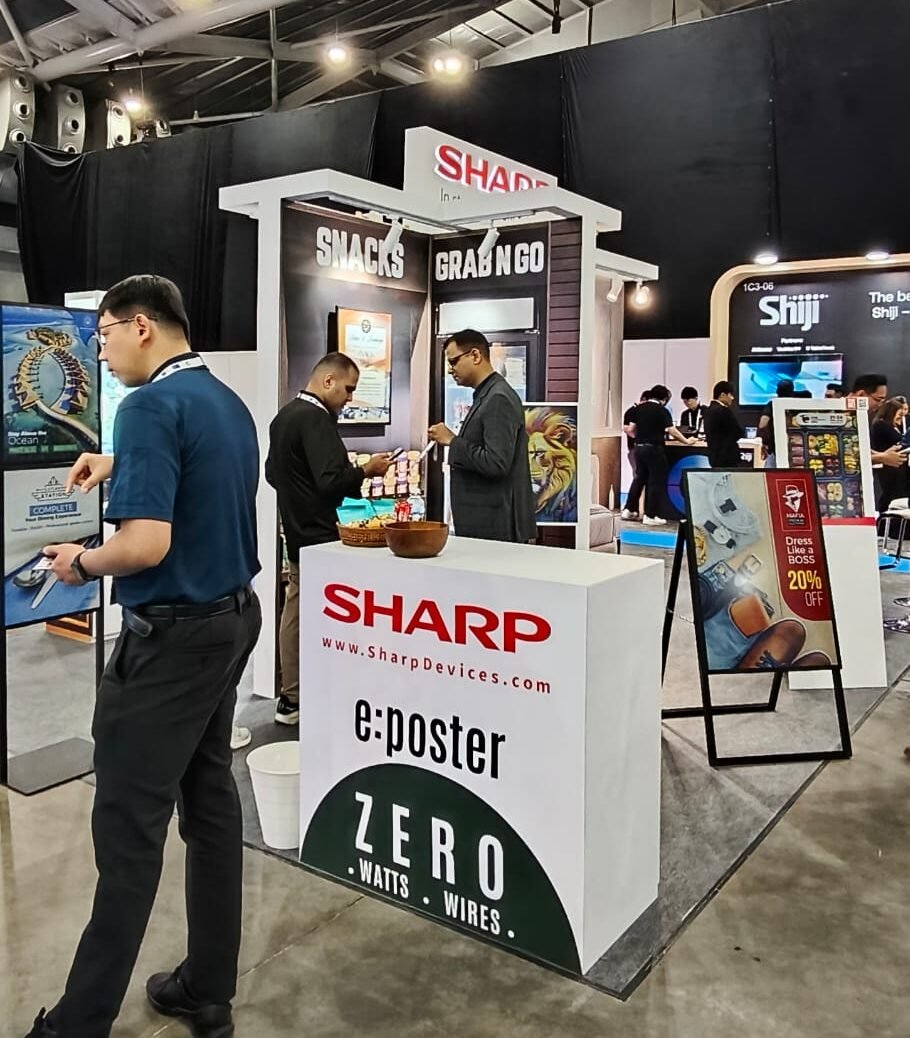
Sharp’s answer to that dilemma is e-paper — more specifically, what the company calls the e:poster, built on E Ink technology enhanced through Sharp’s own IGZO platform. The operating principle is elegantly simple: the screen consumes power only when the content changes. Once an image is set, it holds indefinitely without drawing a single watt. “We are back to the paper days,” says Dr. Ajit, “where we are not consuming energy unnecessarily — and at the same time, we are sustainable, because we are not throwing away paper.”
One Screen, Many Menus — Without the Extra Manpower
That sustainability argument is only half the story. The other half is flexibility, and it matters enormously in the context of how Asian restaurants actually operate.
Restaurant real estate is expensive and tight. In many urban Asian settings, a single wall panel that once held a printed menu must now carry multiple messages: breakfast offerings, lunch specials, dinner promotions, dietary information, and live pricing adjustments. Printing and replacing paper for each service period is labour-intensive, and labour costs are rising everywhere — including in emerging markets.
e:poster changes that equation. “You may have a different message for a breakfast setting, and a different message for a dinner setting,” Dr. Ajit explains. “Manpower is getting expensive everywhere — this is digital, it is automatic.” A single screen can cycle through a day’s needs on a schedule, without a staff member touching it.
The use cases go further. Restaurants that pride themselves on freshness — and are honest with guests about it — can now post time-sensitive discounts in real time. “Some restaurants are very upfront and say: mine is a little older now, two or three hours already, so I am putting a 20 per cent discount on the price,” Dr. Ajit says. That kind of transparency, and the trust it builds with guests, was simply not possible with static print. Sold-out items can vanish from the menu instantly. Seasonal or regional promotions can appear without waiting for a print run.
There is a language dimension to this too. As Asian restaurants increasingly cater to local guests with global tastes, the pressure to communicate in regional languages — not just English — has grown sharply. Smaller operators with limited signage space can now rotate multilingual content on a single screen, serving different guest profiles across different parts of the day. “ e:poster enables us to use that limited real estate sustainably — to carry multiple messages,” Dr. Ajit says.
The Investment Hurdle — And a Familiar Way to Clear It
Newer technology always carries a premium, and e:poster is no exception. Dr. Ajit is matter-of-fact about it: “The newer technology is generally more expensive than current technologies.” But he points to the LED lighting transition as a workable template for how the industry can overcome that cost barrier.
When LED lighting arrived, the upfront price relative to CFL was a genuine barrier. The solution was an innovative split between capital expenditure and operating expenditure — the customer did not have to carry the full hardware cost upfront. Energy service companies pioneered the model, and it worked at scale. “Similar models can be applied to deploy and leverage this new technology,” says Dr. Ajit “The benefit goes to operators and, ultimately, to guests.”
In practice, this means Sharps partners are exploring CAPEX-sharing arrangements — where part of the hardware cost is absorbed upfront — alongside ongoing OPEX-based service contracts. For a restaurant owner weighing a signage investment, the structure is designed to feel less like a large capital outlay and more like a managed service. Neither party absorbs all the risk upfront, and the technology gets deployed.
Sharp Builds the Engine; Partners Drive the Car
Sharp’s commercial model for signage:poster deliberately separates two distinct jobs: building the core technology, and delivering local solutions & service. The company provides the hardware and the underlying platform. Local system integrators — Sharp’s on-the-ground partners in each market — complete the product solutions, installation, provide ongoing support, train staff, and handle downtime when it arises.
“We focus on core technology,” Dr. Ajit explains. “The local partners then cater to local requirements — custom solutions, downtime, hand-holding, helping restaurant and hotel staff really learn the technology and get the best out of it.” It is a model that keeps Sharp focused on innovation while ensuring that an operator anywhere in the region has someone physically available when a screen needs attention. “Every new screen has a slightly different way of working,” Dr. Ajit acknowledges. A knowledgeable local integrator bridges that gap.
Four New Markets, and the Consultant Sitting at the Table
Sharp is currently scaling this ecosystem across four regions: India, ASEAN, Australia and New Zealand, and the Middle East. Until recently, the company operated with a deliberately small number of system integrators while the technology matured. That period of restraint is ending.
“The technology is in a quite mature stage now,” Dr. Ajit says. “We are really scaling up — with multiple partners for different regions.” The move signals confidence that the product is ready for broader deployment, not just controlled pilots.
Alongside the integrator network, restaurant consultants have emerged as a critical piece of the puzzle. In both mature and emerging markets, consultants increasingly shape purchasing decisions before an operator ever speaks directly to a vendor. Dr. Ajit sees this not as a complication but as a structural advantage. “Consultants become a very important bridge between us and the restaurants and hotels. They bring domain knowledge — very deep, expert requirements from the industry — and help match the technology to what the operator actually needs.”
In the HORECA world — hotels, restaurants, and cafés — where operators are focused on delivering guest experiences and running tight services, that translation layer carries real commercial value. Sharp’s pitch is that it enables restaurants to offer newer services and a better experience to guests. The consultant, in that framing, is a natural and welcome ally.
The Bigger Picture
What Dr. Ajit describes is less a product announcement and more a structural shift in how the food service industry thinks about communication. The traditional calculus — paper is cheap but wasteful; digital is flexible but power-hungry — is being disrupted by a technology that delivers flexibility without the energy penalty.
For restaurant operators across Asia navigating rising costs, sustainability pressures, shrinking physical spaces, and multilingual guest bases, the conditions are lining up. The question is not whether the industry will move in this direction. It is how quickly the ecosystem of integrators, consultants, and financing models can make the transition genuinely accessible.
Sharp is betting the answer is: soon.
